2025-12-01 7:00 CET, Germany | Investment Management | Press release
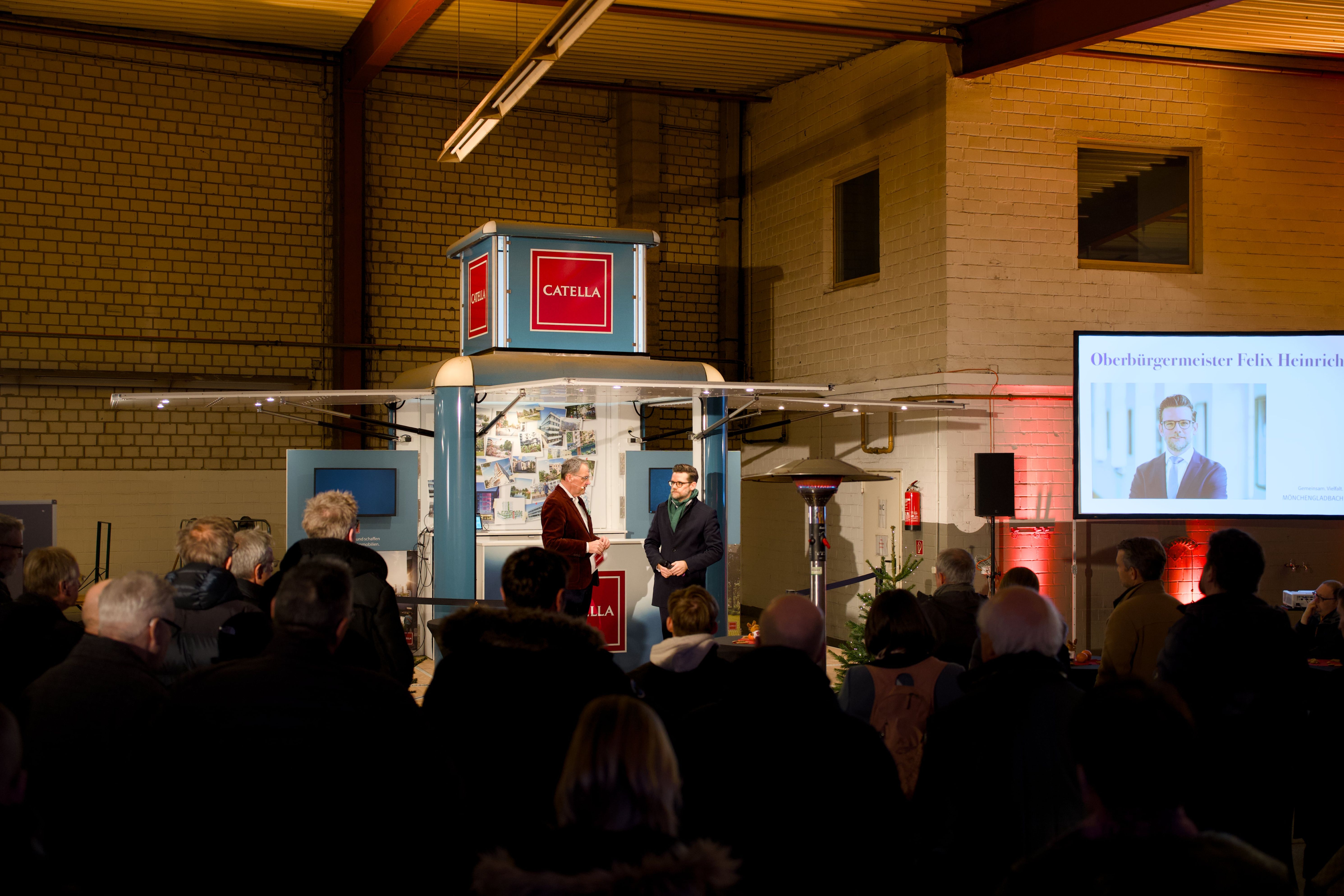
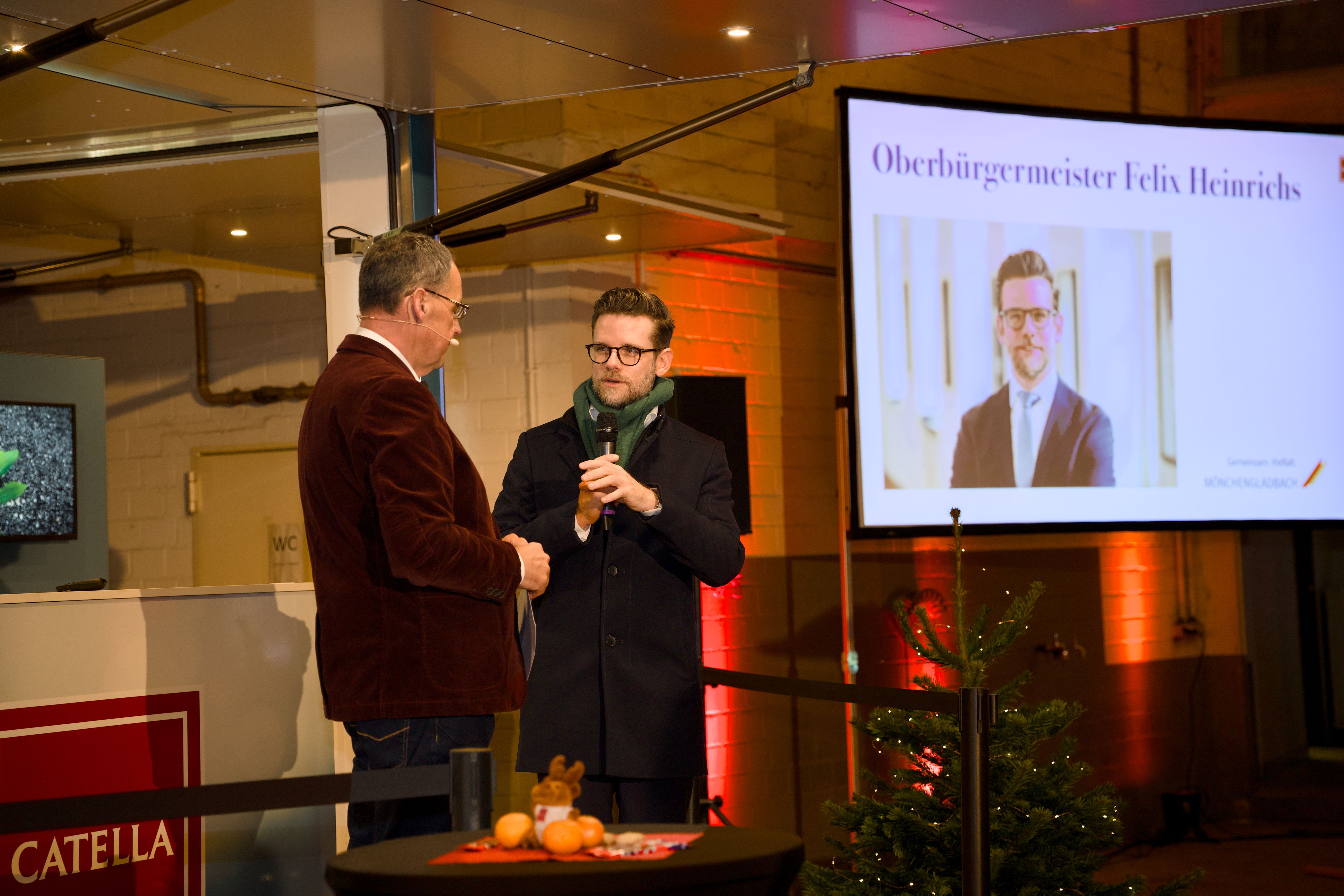
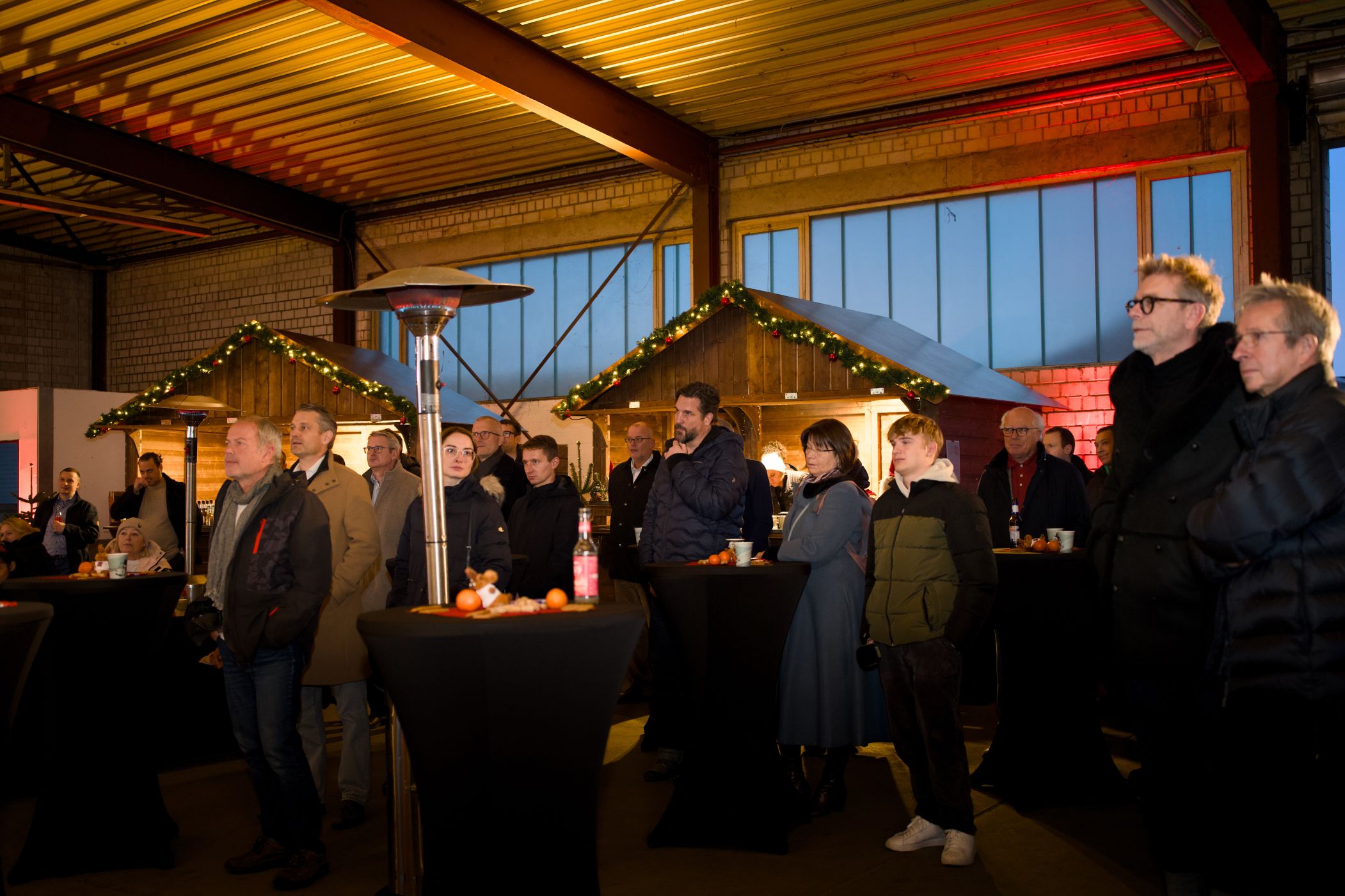
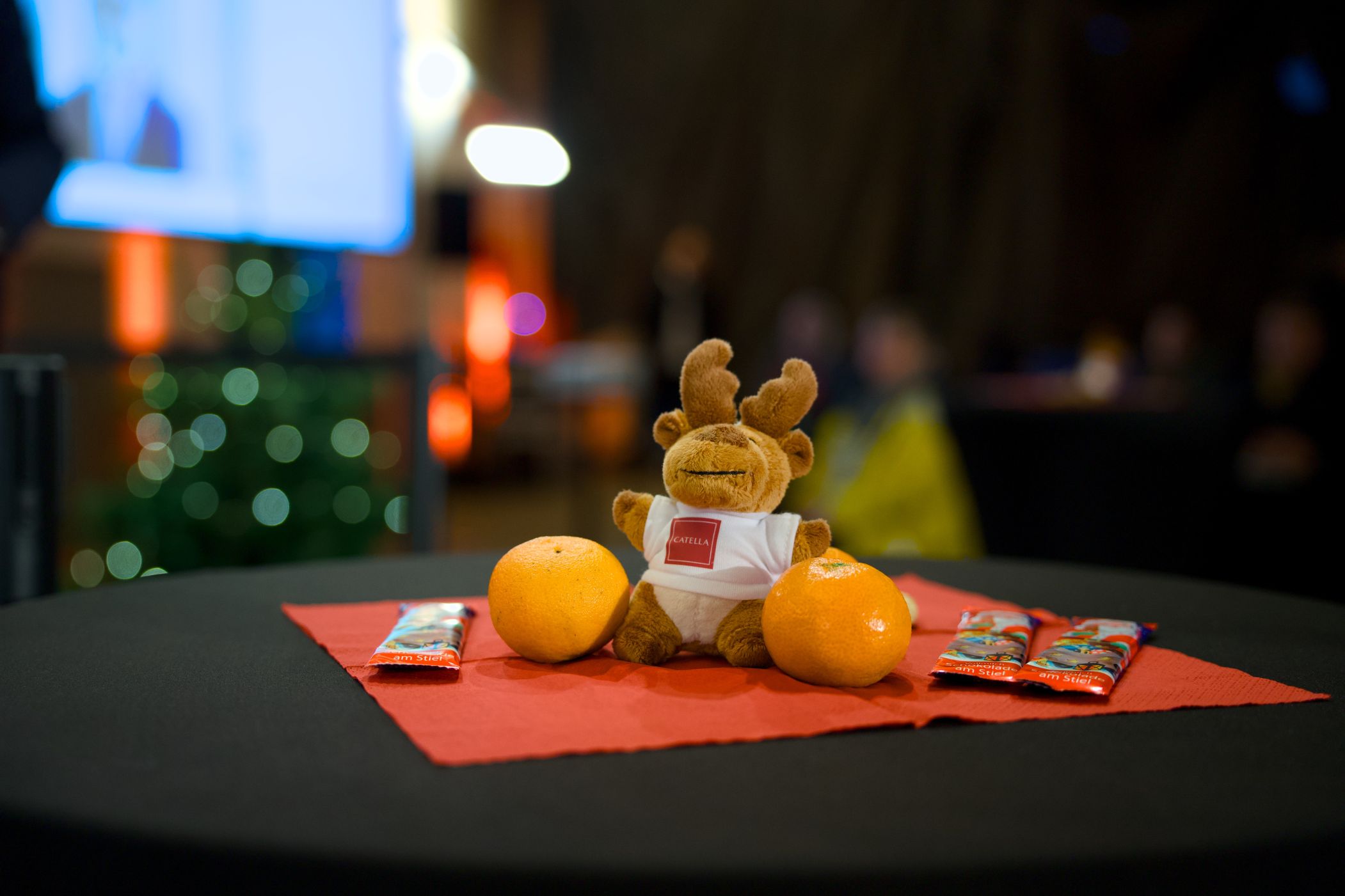
Last Friday, 28 November 2025, Catella Project Management hosted its annual Catella celebration, this time at the Seestadt site. Tenants, neighbours, politicians, administrators, project partners, banks, investors and representatives of the press accepted the invitation to the hall, which was decorated for Christmas, and were given a comprehensive insight into Catella's nationwide housing construction programme CILG – Cooperative Innovative Living Germany.
The festival not only provided an opportunity for exchange and encounters, but also demonstrated on site how affordable, sustainable and at the same time profitable living space can be realised today – independently of government subsidies or the much-cited “construction turbo”.
Mayor Felix Heinrichs and Klaus Franken, CEO of Catella Project Management, opened the event and provided an update on CILG and the development of Seestadt. Mayor Felix Heinrichs emphasised the importance of strong cooperation for urban development: “Seestadt is one of our city's most important projects for the future. It shows how innovative construction, good partner-ships and a clear vision for the future can work together. We are not only creating urgently need-ed housing here, but also a neighbourhood that attracts and empowers people and makes our city more modern and liveable.” Following the successful relocation of the Ismar driving school and the adjustment of the development plan, the next construction phases with around 500 new residential units are now in preparation, the plans for which were presented for the first time during the celebrations.
The Catella Festival demonstrated how the nationwide CILG programme enables affordable, high-quality housing. CILG focuses on modular processes, optimised planning procedures, well-designed floor plans, sustainable energy concepts and the close integration of living, working and leisure. The aim is to support local authorities and investors alike – independently of government subsidies or “construction turbochargers”. “Affordable, sustainable and profitable housing con-struction – it is possible,” explained Klaus Franken, Catella. “We plan differently, we build dif-ferently, we have streamlined our processes and offer good quality at lower costs. In this way, we create living space that remains affordable for the middle class and at the same time enables solid returns.”
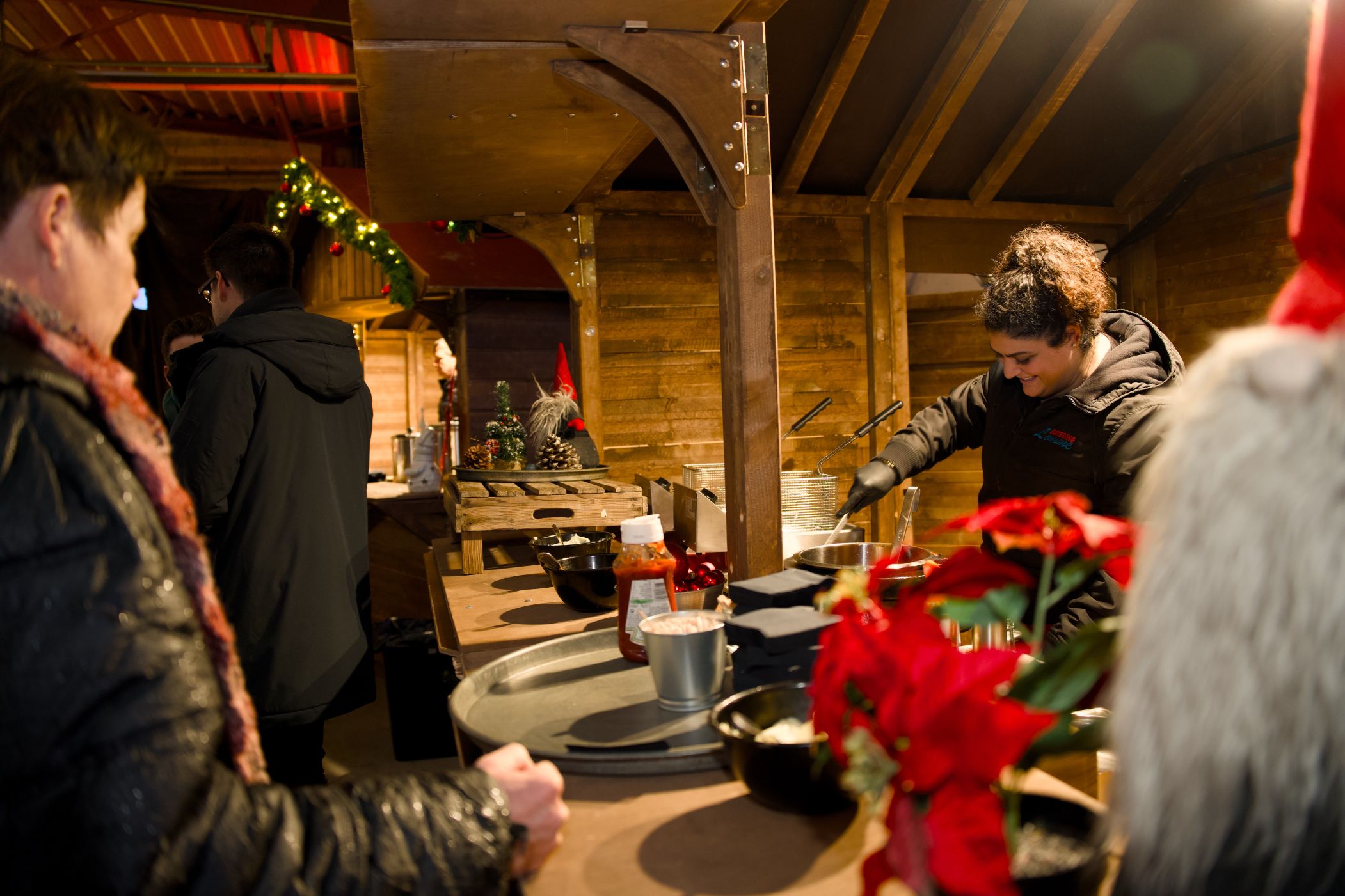
In addition to the presentations and the exhibition of the projects, the specially constructed Christmas market provided an opportunity for exchange and encounters with tenants, the city, Catella and all project partners. A snowboard simulator, a photo booth and winter food provided a varied programme for young and old alike. With a view of the modularly constructed Südviertel district, visitors were able to see for themselves how the CILG concept works – a colourful mix of fun and future prospects.
In addition to Seestadt, Catella presented insights into other CILG projects such as Düssel-Terrassen, the second-largest KlimaQuartier.NRW, with over 800 planned apartments, which celebrated the start of construction in the summer, and the Berlin mixed-use project SILBerlin in Neukölln, which is being developed in a joint venture with Edge and will be one of the most en-ergy-efficient residential buildings in Germany once completed.
The Catella Festival 2025 highlighted how sustainable neighbourhood development, modern mobility and energy concepts, and affordable housing can be combined. With Seestadt, Catella is moving forward together with the city of Mönchengladbach and its project partners, demonstrat-ing how innovation, cooperation and reliability can make the housing revolution in Germany a success. By 2030, the ambition is to build at least 10,000 new residential units nationwide as part of CILG.
With an area of around 14 hectares, potential for over 2,000 apartments and commercial space for around 2,000 jobs, Seestadt is considered one of the region's key projects for the future. It is part of the German government's real-world laboratory for the energy transition and has been recognised by the state of North Rhine-Westphalia as the largest KlimaQuartier.NRW (climate district). The energy-efficient neighbourhood structure is based entirely on renewable systems and enables significantly reduced ancillary costs for tenants. The success of this concept is demonstrated by the Südviertel, the first construction phase to be built entirely using modular construction methods. The 248 apartments have been fully let for over two years, the residents are diverse, and 60 per cent of them have moved in from elsewhere, thereby strengthening the city's purchasing power. The barrier-free apartments with wide doors and spacious floor plans enable age-independent living – a central component of the CILG philosophy. One resident sums it up: “This neighbourhood is green, quiet and full of quality of life. You can really enjoy life here.“
To finance the Südviertel, Catella is working with strong partners such as BayernLB, which is financing the Südviertel with a green loan. The successful relocation of the Ismar driving school to a sustainable new building in the area marks another important step in the overall development of Seestadt. This means that a traditional business in the urban area is being preserved, while at the same time paving the way for the next construction phase. The consolidation of the plots of land is being supported by Stadtsparkasse Mönchengladbach.
Download press release a PDF file
About Seestadt
With Seestadt, Catella is building a so-called “10-minute city” on an area of over 14 hectares, where all areas of life, including living, working, leisure, sports, shopping, culture, etc., are interwoven within walking distance. Its location right next to the main railway station and city centre makes this new, attractive and urban district ideal for young and old, for those with larger and smaller budgets, and for an incomparable lifestyle. In addition to around 2,000 new apartments for all age and income groups, modern office space, restaurants and service facilities are being created, which will provide space for around 2,000 new jobs.
The centrepiece of the project will be a lake covering approximately 20,000 sqm, which will help improve the microclimate, serve as a retention basin, contribute to species protection and, with its natural shore areas and promenades, offer citizens an attraction with a unique quality of life close to the city centre.
Seestadt is part of the Federal Ministry for Economic Affairs and Climate Protection's “Reallabor der Energiewende” and has been certified by the Ministry of Economic Affairs of North Rhine-Westphalia and EnergieAgentur.NRW as the largest climate protection settlement in the state. The award was given for the holistically convincing energy concept, based on the triad of energy generation, supply and consumption, and the attractive urban design. In December 2023, the neighbourhood was additionally certified by the state government as the largest KlimaQuartier.NRW.
The use of renewable energy sources, heating networks with lower flow temperatures and, of course, modern building concepts all contribute to a neighbourhood development focused on optimised climate protection. However, the use of innovative technologies not only offers advantages for the environment, but also for the residents: low heating costs and reduced energy consumption bring tangible financial benefits for all Catella projects.
About Düssel-Terrassen
With the Düssel Terraces, Catella is creating an attractive urban neighbourhood covering an area of over 7.5 hectares in the immediate vicinity of the pedestrian zone of Alt-Erkrath and the S-Bahn station, which is equally appealing to singles, couples, commuters, silver surfers and families. In addition to a good 800 rental and owner-occupied flats for all age and income groups, a four-stream daycare centre, modern mobility services, a parcel station and other neighbourhood services are being created.
From compact one-room studios to spacious five-room flats and terraced houses, all types of accommodation are available at Düssel-Terrassen. All flats are barrier-free and feature large balconies or terraces, spacious living and dining areas with floor-to-ceiling windows, attractive bathrooms and storage rooms within the flat. The highlight of the neighbourhood is the staggered development with a height difference of up to 30 metres, allowing views to the west over the Düssel floodplains to the television tower.
A central element of the Düssel-Terrassen will be the “Green Centre”. The blossoming open space and leisure landscape with its loosely planted fruit trees, larger wooded areas and seating steps makes the “Green Centre” an oasis of experience and well-being in the middle of the neighbourhood. The generously designed play areas with climbing frames, slides, seesaws and swings offer plenty of fun for residents of all ages. In total, the green spaces cover approximately 10,000 sqm throughout the neighbourhood.
In 2020, the Düssel-Terrassen were certified as a climate protection settlement by the Ministry of Economic Affairs of the State of North Rhine-Westphalia and EnergieAgentur.NRW, followed in 2023 by certification as KlimaQuartier.NRW. The awards were given for the holistically convincing energy concept, based on the triad of energy generation, supply and consumption, and the attractive urban design. The use of renewable energy sources, heating networks with lower flow temperatures and, of course, modern building concepts all contribute to a neighbourhood development focused on climate protection. However, the use of innovative technologies not only offers advantages for the environment, but also for the residents: the reduction in heating costs (heating and hot water) and energy consumption brings tangible financial benefits for all residents of the Catella project.
About SILBERlin
SILBERlin is the first joint build-to-rent (BTR) project in Germany by leading European real estate companies Catella and Edge. The joint venture marks Edge's entry into the German housing market and strengthens Catella's position as an innovative partner for sustainable, urban living concepts. At the Silbersteinstraße/Eschersheimer Straße location in Berlin's Neukölln district, in the immediate vicinity of Tempelhofer Feld, a forward-looking building complex with around 92 high-quality rental apartments, including 24 publicly subsidised units, and 1,600 sqm of retail space for a modern local supplier will be built by 2027.
The project is being implemented in accordance with ESG standards and EU taxonomy and, once completed, will be one of Germany‘s most energy-efficient residential properties. The architecture was designed by Anne Lampen Architekten GmbH and combines urban redensification with a high quality of life thanks to a green inner courtyard and clearly separated residential and commercial uses. SILBERlin is part of Catella's nationwide investment programme CILG (Cooperative Innovative Living Germany), which sets new standards for socially balanced, economically viable and sustainable urban development.
The strategic partnership between Catella and Edge has resulted in an exemplary project that demonstrates how affordable, sustainable and high-quality living space can be created in German cities.
About „Cooperative Innovative Living Germany” (CILG)
To achieve the common goal of making housing affordable, Catella is implementing various innovations with its Cooperative Innovative Living Germany (CILG) programme: planning, construction and the entire process are being approached differently. With modular processes and sustainable concepts, CILG is redefining housing construction and creating attractive investment opportunities.
CILG is an innovative investment programme that focuses on strategic partnerships, industrial construction methods and the highest ESG standards. The aim is to provide affordable housing in Germany's most popular cities.
CILG aims to create housing for all age groups and focuses on age-independent, barrier-free living. “With the southern district in Seestadt, we have already created a successful model that shows how sustainable and needs-based housing construction works,” explains Klaus Franken.
By 2030, the ambition is to build at least 10,000 new residential units in Germany. Further information on the Catella CILG programme is available at: https://www.cilg-invest.com.
About Catella Project Management
Catella creates living spaces: Catella Project Management develops new neighbourhoods with a long-term perspective. The company implements the concept of the ‘10-minute city’, with a mix of commercial and residential use, attractive living space for all, a sustainable working environment and the diversity that ensures the long-term value of the neighbourhood. New mobility concepts give people back their freedom in the city; the spaces between buildings are greened and designed for people to spend time and meet. The neighbourhoods developed by Catella are in central locations, are designed to be both car-friendly and car-free, and are forward-looking in their overall design. The ICG's Social Impact Investing Initiative guide, which Catella Project Management co-developed and financed, won the imAward in the Social Responsibility category.
Previous projects include Living Circle in Düsseldorf, Living Lyon in Frankfurt and various commercial projects. The Seestadt and Düssel-Terrassen neighbourhood developments are the two largest certified KlimaQuartiere.NRW neighbourhoods in North Rhine-Westphalia. In the Rhineland alone, Catella is building around 4,000 new apartments, including 147 subsidised apartments in Grand Central at Düsseldorf Central Station. In the office segment, Catella focuses on prime CBD locations such as the green flagship project KöTower, the only high-rise project on Düsseldorf's prestigious Königsallee.
Catella Project Management is part of the Catella Group, Stockholm, a leading specialist in real estate investment and fund management with offices in 12 countries. The group manages assets of more than €14 billion. Catella is listed on the Nasdaq Stockholm in the Mid Cap segment.
More about Catella Project Management: www.catella.com/en/germany/project-management
Press Contact
Klaus Franken
+ 49 211 90 99 35 10
+49 172 3181210
klaus.franken@catella-pm.de